Bring Back the Argument: Why the Dinner Table Is the Most Radical Place Left in America

Twitter gives you a crowd. Your living room gives you a conversation. And right now, in a culture that has confused broadcasting with dialogue, the most subversive thing you can do is pull up a chair and actually talk to someone. The art of the spirited, face-to-face debate isn't dead — it's just moved somewhere the algorithm can't follow.
Let's start with a confession: I have wasted more hours than I care to count crafting the perfect response to something I read online, something that made my blood pressure spike and my fingers move before my brain caught up. And every single time, the response either disappeared into the void, sparked a fifteen-reply thread with a stranger I'll never meet, or — best case scenario — got a few likes from people who already agreed with me. The scoreboard went up. Nothing changed. Nobody moved.
Compare that to the last genuinely good argument I had in person — a dinner party in Chicago, three bottles of wine deep, where someone said something about urban development policy that I found genuinely outrageous, and what followed was two hours of the kind of back-and-forth that left all of us slightly changed. Not converted, necessarily. But moved. Expanded. That's a different thing entirely.
The Viral Sphere Is Not a Conversation
We've spent the better part of a decade being told that social media democratized the public conversation. And in some narrow, technical sense, that's true — more voices have access to more platforms than at any point in human history. But access to a microphone is not the same as access to dialogue. And what most of us have been doing online isn't really arguing. It's announcing.
The structure of every major platform is built around broadcast, not exchange. You post. People react. The reactions that generate the most heat get amplified. The nuance gets compressed into a ratio. The person on the other side of the debate isn't a human being you're trying to understand — they're an avatar, a username, a position to be defeated. You're not trying to think together. You're trying to win in front of an audience.
This is not how ideas actually develop. It's not how minds actually change. And deep down, I think most of us know it, which is why so many people who spend hours a day on these platforms still feel intellectually starved.
The Parlor Tradition and Why It Matters
There's an older model worth recovering. Before the internet, before television, before radio even — the parlor was where culture happened. Not the formal, stuffy parlor of Victorian caricature, but the living room in its truest sense: a space where people gathered to argue about books, debate politics, perform music, read poetry aloud, and generally treat ideas as things worth getting worked up over.
Salons in Paris. Speakeasies in Harlem during the Renaissance. Kitchen tables in Chicago organizing meetings. Front porches in the rural South. The specific setting varied; the function was consistent. People came together, face to face, and they talked. They disagreed. They changed each other's minds — or they didn't, but they understood the opposition better than they had before they sat down.
That tradition didn't die. It just got crowded out. And now, quietly, it's coming back.
What's Happening in the Living Rooms
Across the country, there's a low-key renaissance happening in intimate, analog intellectual spaces. Supper clubs built around a single book or film. Neighborhood philosophy meetups that have nothing to do with any academic institution. Political salons in Brooklyn apartments and Austin bungalows where people with genuinely different views are choosing to sit across from each other and hash it out.
None of this is trending. That's the point. These spaces are deliberately off the grid — not because the people in them are anti-technology, but because they understand that certain kinds of thinking require a different environment. You can't have a real argument in a medium that rewards the most inflammatory take. You can't change your mind in a space where changing your mind reads as weakness.
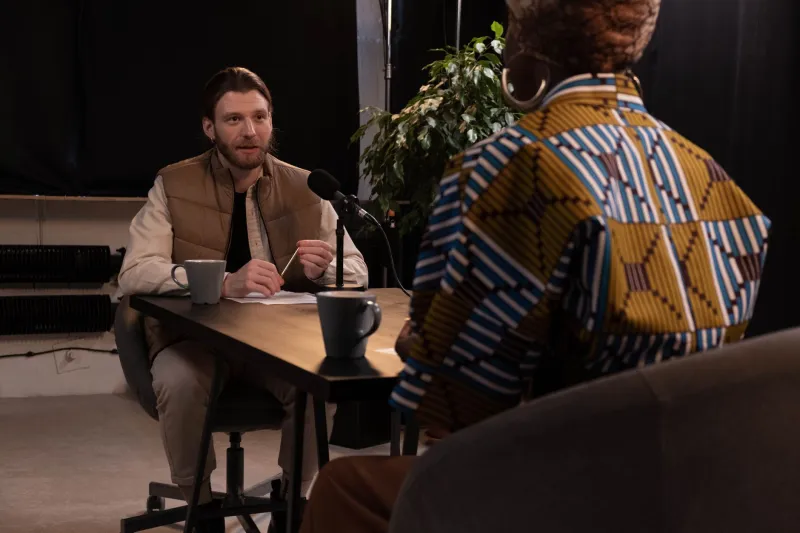
In a face-to-face conversation, the incentive structure is completely different. You can see the other person's face. You can hear the uncertainty in their voice. You can notice when they make a point that lands, and feel the social pressure — the good kind — to acknowledge it. The conversation has to go somewhere because you're both still in the room.
The Stakes of Getting This Right
This isn't nostalgia for nostalgia's sake. The argument for recovering face-to-face intellectual culture is genuinely urgent, because the alternative — a public discourse conducted entirely through viral performance and algorithmic amplification — is making us worse at thinking. Measurably, demonstrably worse.
When every position becomes a brand and every debate becomes a content opportunity, we stop being citizens having a conversation and start being consumers choosing a team. The ideas stop mattering. The winning matters. And a democracy where winning matters more than ideas is a democracy in serious trouble.
The dinner table argument — the real one, the uncomfortable one where someone says something that makes you reconsider a position you've held for years — is a civic act. It's practice for the harder work of living alongside people who see the world differently than you do. It's how we figure out what we actually believe, as opposed to what we perform believing.
How to Actually Do This
Start small. Invite people over who don't all agree with you — not as an experiment, but because homogeneous dinner parties are boring. Pick a topic before people arrive. Not a gotcha topic, but something genuinely contested: urban planning, education reform, what we owe each other as neighbors. Let the conversation go somewhere uncomfortable. Resist the urge to smooth it over.
Put the phones away. Not as a rule, just as a practice. See what happens to the quality of the conversation when nobody's half-composing a tweet about it.
And if someone says something that genuinely changes how you think about a thing — tell them. Out loud. In the room. That's the move that social media has made almost impossible, and it's the move that makes real conversation worth having.
The Most Radical Room in Your House
Here's where we land: in a culture obsessed with reach, with follower counts, with going viral and trending and dominating the discourse, choosing to have a real argument in a small room with people you know is genuinely countercultural. It's a refusal to let your intellectual life be mediated by platforms that profit from your outrage.
The parlor isn't dead. It's just waiting for you to remember why it mattered. Pull up a chair. Pour something worth drinking. And for the love of everything, say something you actually mean.