Turn Off the Murder Docs: The New Podcasts That Actually Make You Think
Let's do a quick inventory of your podcast queue. There's probably something about a woman who disappeared in 1987. There's definitely a comedian interviewing another comedian about their childhood trauma and creative process. There might be a political show that confirms everything you already believe with satisfying regularity. And somewhere in there, buried under the algorithmic recommendations, is probably something you downloaded six months ago and keep meaning to get to — the one that actually sounded different.
This piece is about that last category.
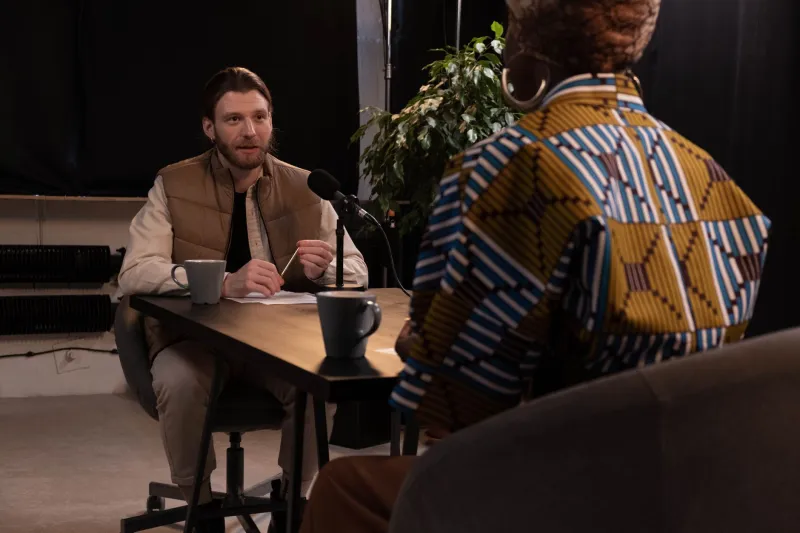
The podcast landscape in 2024 is simultaneously enormous and weirdly monotonous. The medium has never been more accessible or more popular, and yet the dominant formats have calcified into a handful of reliable templates: the investigative narrative, the celebrity confessional, the debate-show-for-people-who-already-agree, the business bro hustle sermon. All of them have their merits. None of them are particularly interested in the strange, uncomfortable, genuinely unpredictable experience of two people — or more — actually talking to each other without a predetermined destination.
But there's a growing counter-current. A loose collection of shows that have decided the most interesting audio content isn't about what's being discussed, but about the how — the navigation, the misunderstanding, the moment where two people with different frameworks find unexpected common ground, or realize they're further apart than they thought. These shows treat conversation as a form, not just a vehicle.
Here's what's worth your time.
Crossroads Radio — Where Disagreement Is the Point
The premise sounds like a setup to a bad joke: a progressive urban planner and a libertarian cattle rancher walk into a podcast studio. But Crossroads Radio, produced out of Denver, has spent two seasons proving that the joke doesn't have to land the way you expect.
Hosts Maya Chen and Garrett Holloway met through a cross-partisan dialogue program and decided to keep recording after it ended. What distinguishes the show from the endless parade of "both sides" political programming isn't some false balance or performative civility — they genuinely disagree, frequently and passionately. What makes it work is that neither host is performing their disagreement for an audience. They're actually trying to figure something out together.
The episode on water rights in the American West is a masterclass in how two people can hold fundamentally different values and still produce something that feels like genuine intellectual progress. Nobody won. That's the point.
Best starting episode: "The Fire Season" — a conversation about climate change and land management that manages to be both technically substantive and genuinely moving.
The Long Table — Dinner Party as Discourse
If you've ever been at a dinner party where the conversation took a left turn into genuinely unexpected territory and you spent the drive home still thinking about it, The Long Table is trying to bottle that experience.
Each episode gathers four to six guests — sometimes thematically connected, sometimes deliberately mismatched — around a literal table (you can hear the ambient sound, the glasses, the occasional overlapping voices) to discuss a single question. Not a hot-take question. Not a culture-war flashpoint. Questions like: What do we owe to people we'll never meet? Or: Is there such a thing as a private belief?
The show, hosted by Brooklyn-based writer and facilitator Dominique Okafor, has a rare quality in audio: it sounds like something you accidentally walked in on rather than something that was produced for you. The guests interrupt each other. They change their minds mid-sentence. Okafor, for her part, knows when to push and when to get out of the way — a skill that is genuinely underrated in the interview world.
Best starting episode: "Forgiveness Is for Who, Exactly?" — a conversation that starts with a philosophy professor and ends somewhere nobody expected.
Frequency — The Science of Being Heard
This one comes at the conversation question from a different angle. Frequency is hosted by a former crisis negotiator named Marcus Webb, who has spent his career in rooms where the quality of a conversation was sometimes the difference between life and death. The show applies that framework to ordinary life — workplace conflicts, family estrangements, political polarization — with results that are both practical and genuinely moving.
What separates Frequency from the crowded "communication skills" self-help space is Webb's absolute refusal to be prescriptive. He's not handing you a listicle. He's documenting what actually happens when people try to reach each other across a gap, and being honest about how often it fails and why.
The episode featuring a mother and adult son attempting to discuss the son's estrangement from the family is one of the most uncomfortable, honest, and ultimately humane pieces of audio content produced this year. It's not comfortable. It's not resolved. It's real.
Best starting episode: "The Room Where It Happened" — Webb's account of a negotiation that went wrong and what he learned from it.
Strangers, Briefly — The Radical Act of Talking to Someone You Don't Know
The most formally inventive show on this list, Strangers, Briefly is built around a simple but surprisingly profound concept: host and producer Yael Santos approaches strangers in public spaces — laundromats, bus stations, public parks — asks for ten minutes of their time, and records whatever happens.
No theme. No agenda. No pre-screening. The show is about what conversation actually looks like when there's no script and no relationship to protect. Some episodes are funny. Some are heartbreaking. Some are just — ordinary, in a way that somehow ends up being extraordinary.
In an era when we've convinced ourselves that meaningful human connection requires the right platform, the right algorithm, the right curated community, Strangers, Briefly is quietly making the case that you could just... talk to someone. Right now. In the laundromat. And something real might happen.
Best starting episode: Honestly, just start at the beginning. The first episode, recorded in a Chicago bus station, sets the tone perfectly.
Why This Matters Beyond the Earbuds
It would be easy to frame this as just a podcast recommendation piece — a list of good things to listen to on your commute. But there's something larger happening in why these shows exist and why they're finding audiences right now.
We are, by most measures, living through a profound crisis of conversation. Not just political polarization, though that's real. But a deeper atrophying of the capacity to be genuinely surprised by another person — to encounter a perspective that doesn't fit your existing categories and sit with the discomfort long enough to learn something.
These podcasts are, in their different ways, practicing something that used to happen in the third places we've lost: the unscripted, unoptimized, occasionally awkward experience of being in genuine contact with another human being. They're not perfect. They're not always comfortable. They don't always end with resolution or consensus.
That's exactly what makes them worth listening to.